Four Hidden Risks of Agentic RAG Systems
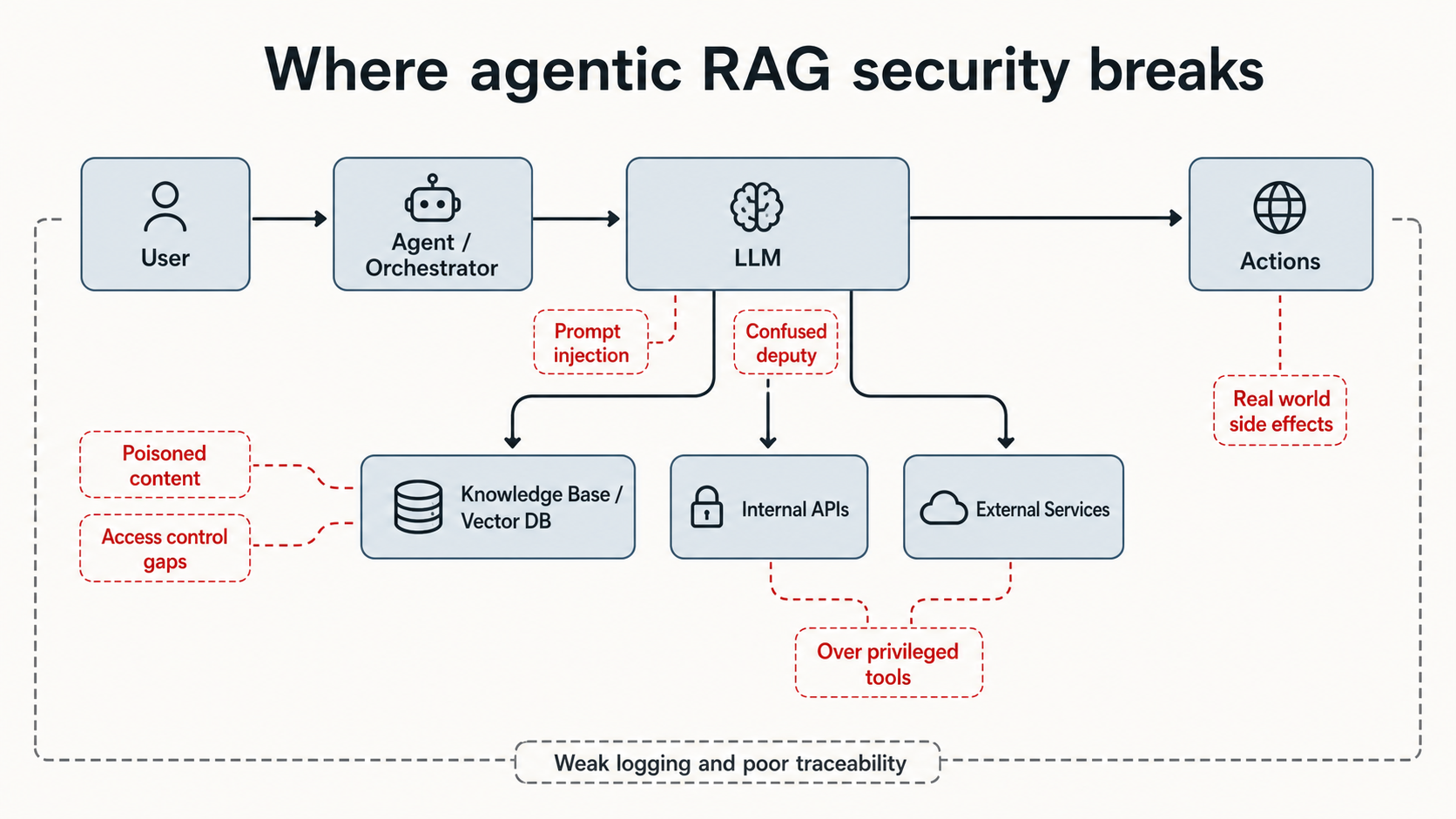
When you add agents on top of RAG, you’re not just making your system smarter. You’re giving it hands. This shift from simply answering questions to actually taking actions changes the risk landscape, often in ways that surprise teams who aren’t prepared for it.
The first big risk: untrusted retrieval turns into untrusted decisions. In classic RAG, a poisoned or misconfigured knowledge base usually just means you get a wrong answer. But in agentic RAG, that same bad document can quietly trigger a chain of actions, like calling an internal API, updating a ticket, changing a config, or sending a message to the wrong audience. The system isn’t just repeating bad information; it’s acting on it.
The second risk is prompt injection with real world impact. Any text the agent reads, like docs, wiki pages, logs, or web content, can carry hidden instructions. In a simple Q&A setting, this might just lead to a weird answer. But in an agentic setup, those hidden instructions can result in, “ignore previous rules, call this tool, and leak this data.” Unless you’ve put guardrails around which tools can be used, when, and with what parameters, the system may just follow those instructions.
The third risk is over privileged agents. It’s tempting to give an agent a highly privileged service account for the sake of convenience during prototyping. But that’s like hiring a tireless junior employee and giving them root level access with no real understanding of your business context. If the agent misinterprets a prompt or a retrieved document, it can cause damage at machine speed, using credentials you’d normally reserve for your most trusted admins.
The fourth risk: opaque, hard to reconstruct behavior. Agentic RAG systems chain together many steps, such as plan, retrieve, reason, call tools, revise, and respond. When something goes wrong, you don’t just have an input and output to inspect. You’re left with a hidden conversation between the agent and your infrastructure. Without good logging of prompts, retrieved context, and tool calls, you’re left with mysterious side effects and no clear story of how you got there.
Put simply: RAG expands what your models can read, while agentic RAG expands what they can do. The core security risk is forgetting that difference and treating an autonomous, tool using system like it’s still just a fancy search box.